Discover
MONTE URANO, AN ANCIENT HILL THAT KEEPS THE MEMORY OF TIME
Monte Urano was born from an ancient border line, where history meets myth.
Its name, originally Monteriano, appears in medieval documents from the Abbey of Farfa and the monastery of San Savino on Colle Vissiano. According to some interpretations, it derives from the Latin Uria or from the combination of the words Mons Therion (“mountain of wild beasts”); others connect it to the mythological figure of the god Uranus, symbol of the sky fertilizing the earth.
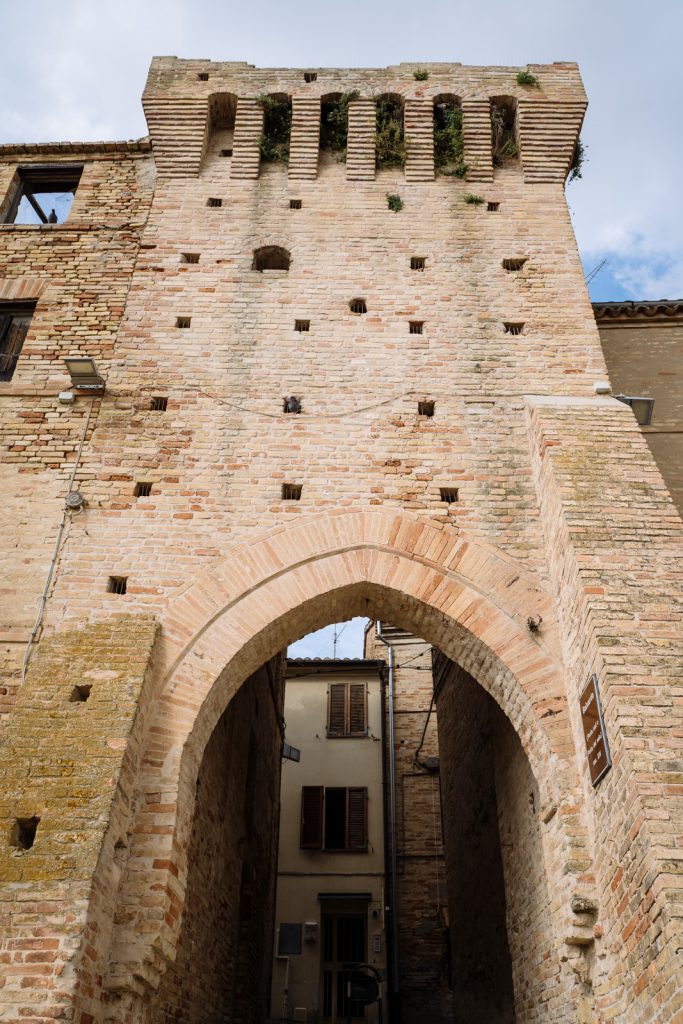
Inhabited since Roman times, Monte Urano emerged between the 11th and 12th centuries as a fortified village linked to the city of Fermo. After a brief period of autonomy, in 1252 it signed agreements with the Ferman podestà Raniero Zeno, maintaining its own statutes while submitting to Fermo’s jurisdiction. The medieval castle, built on the hilltop and surrounded by walls and towers, still represents the historic core of the town, once accessible through the ancient Porta da Sole.
In the following centuries, Monte Urano remained loyal to the Church, sharing the fate of the Papal States until the unification of Italy. The 19th-century urban expansion — with the construction of the Church of San Michele Arcangelo, designed by Giovan Battista Carducci and completed by Giuseppe Sacconi — gave the town the harmonious and orderly appearance it still preserves today.
Its historical memory intertwines with a strong economic identity. The agricultural tradition and rag collection practiced between the 18th and 19th centuries gave way to an enterprising shoemaking craft, which from the 20th century onward transformed Monte Urano into a footwear capital. Today the town hosts dozens of companies and outlets renowned worldwide for their quality, style, and innovation, continuing to tell the story of its proud vocation for work and beauty.
TRADITIONS, CULTURE AND FLAVORS
Monte Urano is a place where flavor meets memory: traditional dishes, folk festivals, and religious devotions create an authentic fabric that tells the story of a community’s soul. Every taste holds a story, every celebration renews a bond with the past.
Among the most important events is the celebration of the patron saint, St. Michael the Archangel, moments that weave together faith and social life, turning the village into a space for gathering and connection.
Religious festivities are joined by popular ones: the traditional “Carnevale Monturanese” and the characteristic Sagra dei Vincisgrassi, held during the Feast of St. John the Baptist — where large trays of baked pasta, handmade and cooked in a wood-fired oven according to tradition, take center stage alongside other typical local dishes.
To honor the town’s deep shoemaking craftsmanship, every summer between July and August Monte Urano hosts the Mercatino della Calzatura — an unmissable event to discover the best local production. Numerous Monte Urano and Fermo-area companies offer high-quality shoes at factory prices, transforming Piazza della Libertà into an open-air showcase of “Made in Monte Urano.”
It is on these occasions that Monte Urano reveals its true essence — made of community, tradition, and the joy of togetherness.